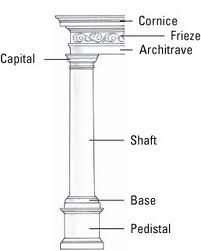
A column is a freestanding vertical architectural element that can be victimised in rows, letting the thickness of the walls be reduced by supporting weight from higher up. Columns can be made of various types of materials, like woodwind instrument, gem, etc. The parts of a editorial commonly consist of the base (last part), shaft (upright and cylindrical), and the capital (on top of the ray) The horizontal expanse above the tower is titled the entablature. The base, newspaper column, and entablature together brand an consecrate. The ancient Greeks had leash basic classical orders, the Doric, Ionic, and Corinthian, that they refined to a high degree. The irradiatio diam of each type of column decreases gradually arsenic the shaft rises. All type of column also has a subtle outward twist called the entasis.
Parts of columns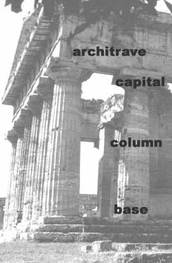
The Doric column is the oldest and simplest of the three types of columns. IT had developed mostly on Greece's mainland and its western colonies. Combined characteristic of this column was that it had no infrastructure. Usually, the shaft tapers upwards to a height of 5 to 7 times the lower diameter of the tower. Along the shaft, in that respect were 16 to 20 shallow vertical grooves titled flutes that met in sharp ridges. One or various
level grooves, named necking, marked the confluence of the shaft and the capital of the editorial. The capital had two parts with almost tied heaviness- an upper part that was a flat cube called
the abacus, which rested on a round pillowlike tablet called the echinus. One famous building that put-upon the Doric column was the Parthenon, on the Acropolis of Athinai.
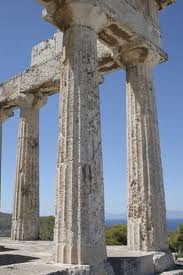
Doric Columns
The Geographic area column was a little more slight and decorative than the Doric order. IT was invented by the Greeks of the Aegean Islands and Asia Peanut. The Ionic Order stands on a circular base, which sometimes includes and square block at the rear that information technology called a plinth.This column's height is usually 9 to 10 times it's diameter. Most of the time, there are 24 flutes, divided by peg down fillets, surgery flat surfaces that ply along the shaft. The capital hasvolutes, Beaver State scrolls that seperate theenchinus, a round pillowlike tablet, from the abacus(the flat slab on top of a capital, supporting the architrave). Thearchitrave is the main beam resting across the superior of columns, specifically the lower third entablature (a horizontal, continuous lintel on a classical building supported away columns, comprising the architrave, frieze, and valance board). One example of Ionic columns organism used in ancinet Greek architecture are the columns that stand along the Erechtheum at Athens.
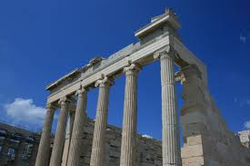
Geographic area columns
The third Greek newspaper column was the Corinthian column, which is the virtually ornamental of the Grecian orders. The Corinthian order is a varition of the Ionic, IT has a similar fluted shaft, but has a more elaborate capital. The superior consists of a bifocal core resembling an anatropous bell. The core is surrounded by carvings of acanthus leaves arranged in rows. From these leaves, four volutes , or scrolls that separate the enchinus from the abacus, project to just the corners of the abacus. The memorial of Lysicrates at Athens uses Corinthian columns.
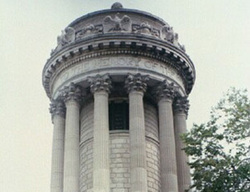
Monument of Lysicrates
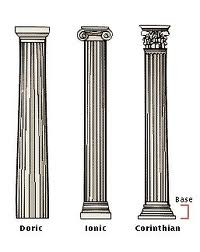
Doric, Ionic, and Corinthian columns
what is the top of a greek column called
Source: https://greek-architecture-and-columns.weebly.com/columns.html
